GH Editorial | Graham Hughes | Editing | Proofreading | Chester, UK
  • Home
  • Services
    • Business editing
    • Editing for publishers
    • Editing into plain language
    • Developing style guides
  • About
  • Get a quote
  • Help
    • Working with me
    • Resources
  • Blog
  • Contact

A year (and a bit) in the life of an SfEP local group coordinator

30/1/2017

0 Comments

 
Working as an SfEP local group coordinator
One of the most valuable things about the Society for Editors and Proofreaders (SfEP) is its network of local groups – a great way for members to get away from their desks, meet some like-minded souls, and swap ideas and advice.
 
Towards the end of 2015, a volunteer was needed to become the next coordinator for the Manchester group. Having been in the group for a couple of years, I felt settled in and was tempted to step forward – but also felt slightly uneasy about some aspects of the role, especially chairing meetings. Then, though, I went to my first SfEP conference and came away full of positive thinking: ‘Yes,’ I thought, ‘I’ll do it’. So I did.
 
I wanted to keep up the good work of my predecessors, Louise Bolotin (who had founded the group, and was helped by Paula Clarke Bain) and Tammi Merrell. I didn’t have any big changes in mind, but the group was quite small, typically with between six and ten attendees at the meetings, and I hoped to expand it.
 
So, well before arranging my first meeting as coordinator, I searched for potential recruits on the SfEP’s member list, and considered also looking for non-members through social media. But, before I had gone as far as contacting anyone, along came a flurry of emails from prospective newbies, and I put the recruitment drive on hold – probably for good, as it turns out.
 
At that meeting, in January 2016, there were fourteen of us – far more than ever before. It was a strange day: I started it feeling nervous about chairing the meeting – especially with such a big turnout expected – but was soon knocked sideways by the news of David Bowie’s passing, and hardly even thought about the meeting until I went to Manchester in the evening. The nerves had subsided by the time it started. (A year later, I chaired a meeting a few hours after getting some health news of my own that gave me plenty to think about – nothing life-threatening, though.)
 
There were only nine people at the next meeting, in April – more like the old days – but we then had twelve on a sweltering night in July. We were using a small, semi-secluded room in a large bar, which was ideal for the numbers we’d had before (except for the background noise of chatter, music and tinkling glasses, which could be a minor problem), but was now starting to get crowded.
 
This created a dilemma: I wanted to do something about the crowding, but certainly didn’t want to discourage people from going. Luckily, the same venue has a ‘Boardroom’ upstairs, which the management are now allowing us to use free of charge (on the understanding that we’ll spend a reasonable amount at the bar). We now have a table with space for fourteen, or more if we spread out (and there are plenty of spare chairs), and no background noise to speak of. Since moving to our plush new accommodation, we’ve had turnouts of fourteen in October and twelve this January.
 
Even these numbers don’t reflect the growth in interest in the group since the autumn of 2015. The invitation list (including non-members of the SfEP) has nearly trebled in size, from 17 to 47. I’m not claiming any credit for this – I don’t think it can be attributed to anything I’ve done other than responding to, and keeping track of, all those who have shown an interest. I’d like to think it reflects the good health that the SfEP is in, especially as it embarks on its drive for chartership.
 
So, what exactly does a local group coordinator do? There are, of course, the meetings (quarterly in our case):
  • booking the room
  • setting the agenda
  • sending out an invitation
  • keeping track of who says they’ll attend, who sends apologies and who actually does attend
  • taking and distributing the minutes.
I also feel a responsibility to make every newcomer feel welcome and involved, though this is quite a challenge when there are around six or seven making their first appearance all at once.
 
Another part of the role – quite a big one over the last year or so – is to respond to initial contact from new people, usually members or prospective members of the SfEP who are interested in attending the next meeting.
 
I also
  • keep a list of people who’ve attended meetings, or at least expressed an interest in doing so
  • moderate the group’s online forum and encourage people to use it
  • give the SfEP’s community director a monthly update
  • provide occasional updates for the group’s page on the SfEP website
  • run our Twitter account (not very well)
  • occasionally arrange other events such as a Christmas get-together.
 
​This doesn’t all have to be done by one person: the duties can be shared with other group members, and some groups have two or more co-coordinators(?). Also, the range of activities can vary between different groups.
 
Being a group coordinator has been very rewarding and enjoyable, and a nice challenge. It’s good to feel that I’m contributing to the SfEP, hopefully encouraging newcomers to sign up, and helping SfEP colleagues – who happen to be a really good bunch of people – to reap some of the benefits from their membership. To anyone who is thinking about becoming a coordinator, I would say: if you have a bit of time to spare and some half-decent organisational skills, and aren’t thoroughly terrified at the prospect of chairing meetings (which isn’t as scary as you might think), why not give it a go?
0 Comments

Difficult decades

15/11/2016

0 Comments

 
Picture
The twenties will soon be with us again …
​While reading a George Orwell essay a few years ago, I was momentarily thrown by a mention of ‘the nineties’. Was he already looking beyond 1984? It soon dawned on me that he meant the 1890s – a decade that was fairly recent in his day, but now seems far behind us.
 
Editors and linguists often talk about how elements of the English language evolve over time as a result of social change, migration, technology and so on. Well, here’s one that sometimes has to change purely because of the passage of time.
 
For the best part of a century, we had handy names for decades: the twenties, the fifties, the seventies – right up to the nineties. People began to associate them with trends in fashion, music and social attitudes: the Roaring Twenties, the Swinging Sixties.
 
The first two decades of the twentieth century (as with any other) didn’t lend themselves to handy labels: ‘the 1900s’ could be taken to mean 1900 to 1999, and ‘the 1910s’ has a certain awkwardness because its pronunciation – ‘the nineteen-tens’ – bears little relation to the names of its individual years. Later, though, people got used to omitting the ‘nineteen’ part in less formal contexts: hence ‘the twenties’ and so on.
 
This was all very neat and tidy until we hit 2000. Suddenly, we were in another era of apparently nondescript decades. Few people seem to be interested in distinguishing between the 2000s and the 2010s, or in associating these decades with trends. No doubt this is largely because they lack catchy names (‘the noughties’ and ‘the teenies’ were suggested, but, thankfully, never really caught on), but it might also be a hangover from the impact of reaching ‘The Year 2000’. After such a dramatic change in the year number, with all four digits changing at once, perhaps decades seemed less significant than before. Have we got out of the habit of affording importance to them?
 
It won’t be long before this is put to the test. In just a few years it will be the twenties all over again; soon, to some extent or other, people will start looking ahead to that decade.
 
For those of us who write, edit or proofread for a living, and those who manage the style guides that we follow, this will present a new challenge. How ambiguous will ‘the twenties’ be? Should we refer long-windedly to the ‘1920s’ and ‘2020s’, or even – where the style rules demand the use of words – the ‘nineteen-twenties’ and ‘twenty-twenties’, to prevent any possible confusion? Will these twenties roar or just whimper?
 
Twenty years ago, there was no real problem with the term ‘the nineties’, as the 1890s were rarely mentioned; but the 1920s – a period of radio, films and wild dancing – still seem quite familiar today. A reference to ‘the twenties’ might conjure up that decade in the reader’s mind, unless the context makes the correct meaning instantly obvious.
 
Meanwhile, roll on the (twenty-)twenties …
0 Comments

ESL writing tips, #1: ‘in case’ or ‘if’?

12/10/2016

1 Comment

 
English writing tips - choosing between 'if' and 'in case'
The first in a (possible?) series of posts about issues that often crop up in the work of ESL (English as a Second Language) writers.
 
I recently found a sentence similar to this, in a research paper written by an ESL author:
 
In case a new best solution is found, the search begins again, based on this new solution.
 
The intended meaning of ‘In case’ was actually ‘If’, like this:
 
If a new best solution is found, the search begins again, based on this new solution.
 
What’s the difference? In UK English, there is a clear distinction: ‘if’ is used for a conditional statement, while ‘in case’ indicates something that is done as a precaution.
 
Let’s look at another example:
 
If it’s raining, I’ll take my umbrella.
 
This is conditional. It means I will check the weather before I leave; then, if it’s raining, I will take my umbrella. If it isn’t raining, I won’t take it.
 
Compare that with this:
 
I’ll take my umbrella, in case it starts raining later.
 
This means I’m being cautious: I’ll definitely take my umbrella, whatever the weather is like when I leave, because it might rain later.
 
In US English, ‘in case’ can mean the same as ‘if’, but this is quite unusual. To avoid confusion, whenever you mean ‘if’, it seems sensible to use that word.
 
By the way, if you do use ‘in case’ for either of these meanings, it must be two words: ‘incase’ is a variation of the verb ‘encase’, which is completely unrelated to all of this.
1 Comment

Looking back at #sfep16 – the 2016 SfEP conference

18/9/2016

4 Comments

 
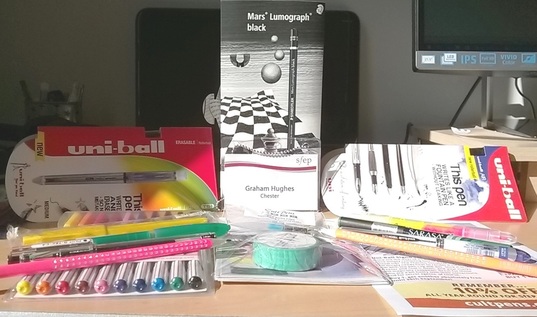
SfEP conference 2016 - goody bag from Cult Pens
Some goodies from the goody bag from Cult Pens, one of the conference's sponsors
From 10 to 12 September, I was at Aston University in Birmingham for the 27th annual conference of the Society for Editors and Proofreaders (SfEP).
 
This was my second SfEP conference, the first being last year’s gathering in York. That time, I arrived with some trepidation, as if I was going to be surrounded by veterans who were out to judge me. I soon realised, though, that this was nonsense. Everyone was there to learn, share ideas and enjoy themselves. This year, I could turn up without any of those worries. The experience that I’d gained in the last 12 months also helped me feel more confident, and being a local group coordinator had possibly even put a slight swagger into my step.
 
Choosing the sessions to attend hadn’t been easy, with some timeslots having at least two that caught my eye. In some cases, it had been a question of whether to pick the one that seemed most interesting or the one that seemed most useful.
 
The venue was superb, with good-quality hotel-style accommodation, and great facilities for the sessions, breaks and meals. Fortunately for the lazier types among us, everything happened in two buildings that were only a few minutes’ walk from each other.
 
Day 1
 
Although the conference didn’t officially open until late afternoon, there were a couple of pre-conference software sessions available earlier, and I opted for Kathryn Evatt’s ‘Using Google Docs’. After some lengthy technical hitches, it was interesting to learn about the ways in which this web-based software can be used for collaborative writing and editing.
 
Having missed the SfEP AGM last year, I wasn’t sure what to expect from it this time, and braced myself for a possible 90 minutes of tedium. As it turned out, though, it managed to be quite enjoyable.
 
Things really started to get going in the early evening, when quite a crowd gathered in the bar, while the first-timers were treated to a drink with the SfEP council members in the next room. As we moved on to the restaurant for dinner, I inadvertently plonked myself next to the proofreading legend that is Louise Harnby; soon I was gushing to her about how useful her books on business planning and marketing have been. We then stayed at the same tables for a pub-style quiz, ably hosted by conference director Christine Vaughan – a late rally saw our team end up in something like fourth place.
 
Day 2
 
The main theme of the Sunday sessions, for me, was editing for non-publishers, such as businesses and public-sector bodies. Michelle McFadden and Amanda Picken’s ‘Non-fiction text’ gave some good insight into the main issues involved in working for such clients, and the qualities that they tend to look for in us. Later, in ‘Editing business text’, Sarah Hunter of the Financial Conduct Authority looked at the problems often caused by unclear, verbose wording in informational content, and how we can help to prevent them. Plain-language editing has been on my radar for a while, and this session has jolted me into exploring it sooner than I would have done.
 
During the afternoon, while other attendees were relaxing through an hour-long coffee and tea break, around 15 of us hard-working (cue violins) local group coordinators had a meeting, chaired by Ruth Durbridge, the outgoing regional development director. There was much talk about how to persuade more SfEP members to go along to meetings and other group events (I tried not to look too smug about the fact that our Manchester group has been in danger of having too many people turning up), and about which form of communication to use: the local group’s forum or email (I’m among those who feel the forum is far better, and keep wondering why so many people are reluctant to use it).
 
There was also a humanities-themed ‘Live editing’ session, led by Laura Poole of Copyediting.com, where we edited two short texts and discussed the changes and queries we had come up with. This was one of several ‘live’ sessions, a new idea introduced at this conference.
 
Sunday evening was time for a drinks reception and the all-important gala dinner. The SfEP’s singing troupe, the Linnets, went into rap mode and treated us to ‘Let’s Talk About Text’, based on the Salt-N-Pepa hit ‘Let’s Talk About Sex’. Yes, this did happen. Our after-dinner speaker was American linguist Lynne Murphy, with some funny and thought-provoking observations on differences between UK and US English (a subject that’s often discussed in hackneyed, repetitive style, but not this time). Thought for the evening: which part of your face do you frown with? Most of us then escaped to the bar, rather than run the risk of seeing editors dancing.
 
Day 3
 
Monday began with the ‘Sense and sensitivity’ session, presented by former SfEP chair Sarah Price, with useful debate on how and when to apply various rules (or ‘rules’?) of grammar and punctuation.
 
Sophie Playle then dished out valuable advice on ‘Making the most of your website’. After lunch, a ‘Speed shake-up’ session hosted by Ruth Durbridge, Ian Howe and Julia Sandford-Cooke gave established editors (mostly much more established than me, I suspect) a raft of ideas about strategic career planning, continuous professional development and expanding (or, if you prefer, ‘getting out of’) your comfort zone.
 
I’m not sure that any SfEP conference can be complete without a talk from our honorary president, the linguistics expert David Crystal. His closing lecture was an entertaining look at how the internet is changing our conception of ‘the text’.
 
After the handing out of raffle prizes and some closing words, it was back into the outside world, walking back to New Street station – a weird experience after two-and-a-bit days in our on-campus editorial bubble. (Who are all these people in the street? Aren’t they editors? If not, why not? etc.) Amazingly, thanks to a train delay that actually worked in my favour at Crewe, I was home just two hours after the close. That evening, even though sleep was beckoning after a demanding few days, my mind was buzzing with thoughts.
 
Back to life
 
Since then, I’ve written up a pile of notes, reread some handouts and made all sorts of follow-up plans – I just hope I manage to put most of them, at least, into action. There’s so much to take away from the conference – every session was of great value.
 
Not only that, but it’s a real pleasure to meet so many like-minded people, catching up with familiar faces from the local groups, the forums and last year’s conference, and meeting new ones. (Though it can be a bit disconcerting to meet someone whose face you only know as a forum avatar. Look – that mouth moves! It makes a sound!)
 
Some people seem to imagine that editors and proofreaders are a stuffy, serious bunch, and that our conferences must be painfully dull. Wrong! Now, I won’t claim that we’re a crazy gang of party animals, but both the conferences I’ve attended have been awash with funny, interesting, friendly people who make for great company. Most of us work alone, and that makes it especially important to get together and share experiences, thoughts and tips. It can be almost overwhelming, though, to suddenly find yourself with about 200 colleagues, and some attendees feel the urge to get away for a quiet breather at times during the conference.
 
We’ve come from all sorts of backgrounds – publishing, journalism, teaching, engineering, IT, you name it – and I think that helps to create a varied mix of approaches and attitudes to our editing and proofreading, as well as helping us to get involved in a wide range of work. It also means there are many different stories about how we ended up here.
 
Here comes my attempt at some sort of interesting thought. This isn’t the kind of work that tends to attract people with big egos. We don’t get much publicity, the pay isn’t spectacular, and there are no glittering awards ceremonies or flash company cars on offer to the high achievers. I think this lack of ego helps to make our conferences so enjoyable – there are no bigheads or bigmouths dominating the show and drowning out the quieter people, and this leaves plenty of space for everyone to have their say.
 
Huge credit is due to the people who helped to make the conference happen: Christine Vaughan, her SfEP council colleagues, the office staff, sponsorship coordinator Sherona Treen-Coward, and the members who volunteered to help out. (Hope I haven’t forgotten anyone?) It ran so smoothly, and every possibility seemed to be catered for. I honestly don’t know how they do it.
 
On to next year
 
During the week leading up to the conference, my heart sank slightly when I noticed that next year’s event will be at an out-of-town venue on the Bedfordshire/Cambridgeshire border – a bit remote for someone up here in the North West without a car. By the time I’d got back, though, I was beginning to dread the thought of missing an SfEP conference; and, especially considering the heroic efforts others have made to get to them, I’m fairly sure I will be there, whatever it takes. Plus, there are some lucky souls who I haven’t really spoken to yet, despite having been at one or even two conferences with them – something needs to be done about that.
 
If you’re an SfEP member and you’re nervous about the idea of going to a conference, please give it a go next year if you can. It’s a safe bet that you will feel at home, enjoy the company, learn a lot, and go away full of ideas and optimism about your work. Honestly, you won’t regret it. Don’t just take my word for it – here’s what some other people think (not forgetting the reactions on Twitter: see #sfep16):
  • Sara Donaldson
  • Sophie Playle: part 1 | part 2
  • Melanie Thompson
  • Katherine Trail (on video)
4 Comments
Forward>>
    Thoughts on Words

    ​​An editorial blog. Posts by Graham Hughes.

    Archives

    July 2025
    January 2025
    July 2024
    January 2024
    December 2023
    April 2023
    August 2022
    May 2022
    November 2021
    May 2021
    February 2021
    January 2021
    October 2020
    September 2020
    June 2020
    April 2020
    February 2020
    October 2019
    May 2019
    February 2019
    November 2018
    August 2018
    June 2018
    April 2018
    January 2018
    October 2017
    August 2017
    May 2017
    January 2017
    November 2016
    October 2016
    September 2016

    Categories

    All

    View my profile on LinkedIn
Home
Services
​○ Business editing
​​○ Editing for publishers
​○ ​Editing into plain language
​○ ​​​​​Developing style guides
About​
Get a quote​
Help
○ Working with me
​​○ Resources
Blog
​Contact

Terms and conditions
​

​Data protection
​
​
Cookie policy

​​
​Copyright © 2012–2025
​Graham Hughes
​Chester, UK

Picture
Graham Hughes - Advanced Professional Member of the Society for Editors and Proofreaders (SfEP)
  • Home
  • Services
    • Business editing
    • Editing for publishers
    • Editing into plain language
    • Developing style guides
  • About
  • Get a quote
  • Help
    • Working with me
    • Resources
  • Blog
  • Contact